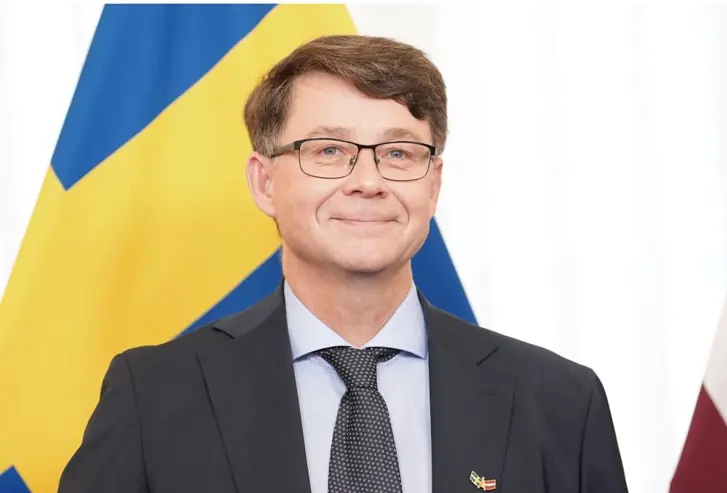
Daniel Olsson, Ambassador of Sweden to Latvia. Article published in Latvijas Avize, April 2026 (Foto: Edijs Pālens, LETA)
The world is in turmoil – and changing rapidly. Much of what used to be self-evident is now unclear, as president Rinkevics wrote when Latvia celebrated its 105th de jure anniversary earlier this year.
Countries like Sweden and Latvia now invest much more in our security. We decisively implement NATO’s Haag Summit decision to increase defence-related spending to 5 percent of GDP, thereby shifting greater responsibility for ensuring NATO’s conventional defence to European countries. We are top providers of aid to Ukraine, like other Nordic and Baltic countries.
These investments are absolute necessities. The threat from Russia to Euro-Atlantic security needs to be met from a position of strength.
***
Now, the foundation for our security and our power is a strong economy. In the current circumstances, defence and economy are clearly two sides of the same coin.
To finance defence investment, EU Member States have the possibility and credibility to increase borrowing. Many do so. The risk of larger debt is, rightly, deemed smaller than the risk of not investing in defence.
But this cannot be the long-term European solution, as we are facing a generational task to deter Russia and at the same time need to meet other needs in society.
To increase our security, we must grow our economies. We must do so at a time when world trade is challenged, geopolitics is fracturing, and technological change is rapid.
Standing still means falling back: gradually less prosperity and security.
For these reasons, the EU must urgently increase its competitiveness.
That is why Sweden, Finland, Latvia, Estonia and Lithuania and the Netherlands, have listed to our EU partners the priorities we see would have the most effect:
First, strengthen EU’s single market - for goods and services alike - to foster greater competition, higher productivity and lower prices for consumers.
Second, increase access to private capital in the EU. This is key to start and scale up businesses. More than 11 000 billion Euros is currently dormant on either saving accounts or in cash.
Third, make it easier to start and run a company in the EU – an ambitious simplification agenda with focus on reducing burdens on business.
Fourth, increase our trade and economic security while decreasing our dependencies.
Fifth, continue the clean transition and energy production – a geopolitical necessity and economic opportunity alike.
Businesses should move to the EU to grow, not the opposite. Business should see the EU as the place where they can find capital, talent, research and innovation, simple and supportive legislation, a large single market without boundaries, and clean and abundant energy supply.
The EU can offer predictable conditions based on rule of law and this is a real competitive advantage. The trade agreement with South American trade area Mercosur as well as the new deals with India and Australia are proof of EU’s attraction as a trade partner.
***
The measures on the EU level should be complemented by structural reforms nationally to make us more, competitive.
Such reforms as rarely politically easy and complex trade-offs must be made. We can learn from each other in the union and especially among the Nordic-Baltic countries.
Sweden has valuable experiences with structural reforms in some areas discussed in other countries, such as capital markets and privatization. And Latvia is growing its economy while decreasing dependencies and facing two antagonistic neighbours.
Sweden and Latvia are close partners in economy, as in almost any field. Sweden is the largest foreign investor in Latvia, and we want to continue deepening our economic relations.
To that end, a business delegation with some 80 Latvian companies - in security and defence as well as clean transition - will visit Sweden in May to further boost trade and investment. Our shared security will benefit, too.
***
Russia’s threat to European security illustrates how security and economy is interlinked.
Russia’s economy is increasingly struggling, even if Moscow is trying to hide the truth on its growth and inflation. Russia can keep financing its war of aggression on Ukraine - but only at the price of depleting its resource base.
So Russia may be able to afford guns, but not much butter. The EU is able to do both. The economic power of the EU vastly outweighs the Russian economy. Even the combined economies of the 33 million Nordic-Baltics are not far from the size of Russia’s.
To fully leverage this advantage, we must make the necessary reforms to strengthen the European economies - while continuing to weaken Russia’s through sanctions.
An economically stronger and more competitive EU will be much better able than Russia to sustain the military, economic and political confrontation.
At the end of the day, European competitiveness is ultimately about our power to choose our future and to protect our freedom.